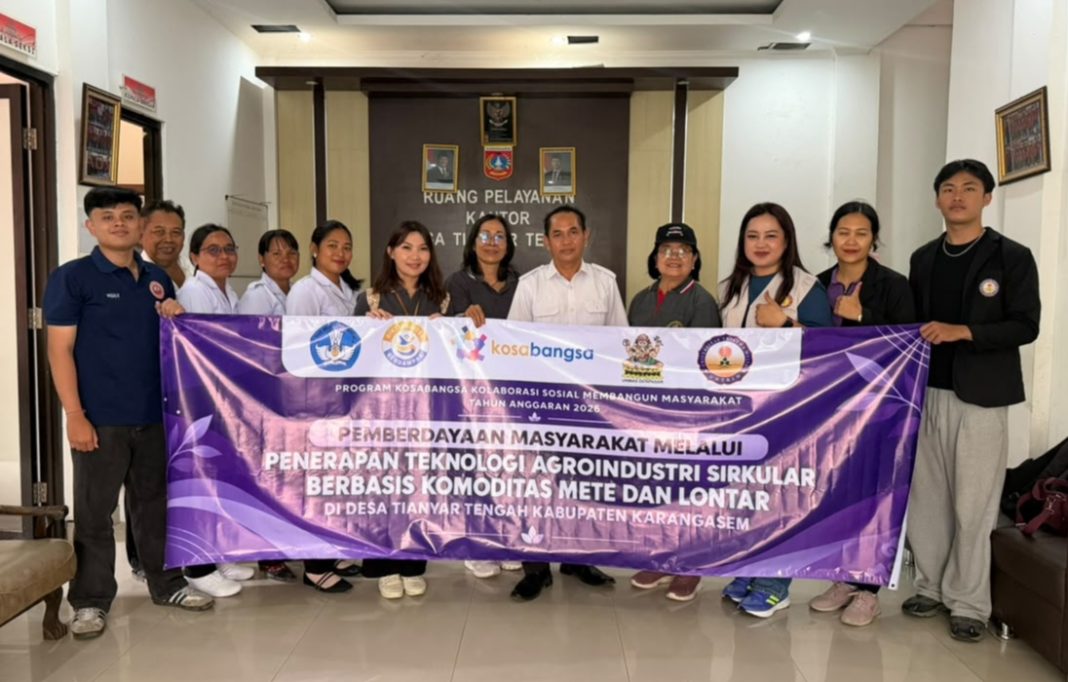
KARANGASEM, fokusbali.com – Efforts are continuing to boost the economic value of local commodities—cashews and lontar palm—in Tianyar Tengah Village, Kubu Subdistrict, Karangasem Regency, through the application of technology and agroindustrial innovation.
These efforts are being realized through the Social Collaboration for Community Development (KOSABANGSA) Program for Fiscal Year 2026, under the theme “Community Empowerment through the Application of Circular Agro-Industrial Technology Based on Cashew and Lontar Commodities in Tianyar Tengah, Karangasem.”
This program aims to enhance the community’s capacity to transform local resource potential into economically valuable products, while optimizing the use of agricultural byproducts through a circular economy approach.
The activities involve two target partner groups: the Subak Abian Dalem Farmers’ Group—a cashew farmers’ group with 22 members and the Sari Pertiwi Women Farmers’ Group (KWT), with 20 members, which specializes in processing lontar palm products.
Until now, the potential of cashew and lontar in the Central Tianyar region has not been fully utilized.
Many cashew farmers still sell their harvest in bulk, while the processing of lontar-based products still faces challenges in the production process particularly the inconsistent quality of palm sugar, which does not yet fully meet marketing standards.
These conditions form the basis for an empowerment program that integrates technology adoption, skills enhancement, and community business development.
In the Subak Abian Dalem farmers’ group, activities are focused on developing processed cashew products, such as cashew jam and ready-to-eat cashew nuts.
In addition, byproducts from cashew processing are utilized to make briquettes as an alternative product with economic value. Meanwhile, at the Sari Pertiwi Women’s Group (KWT), the program is directed toward the development of liquid lontar sugar and lontar palm sugar, as well as the utilization of lontar waste into liquid organic fertilizer (POC).
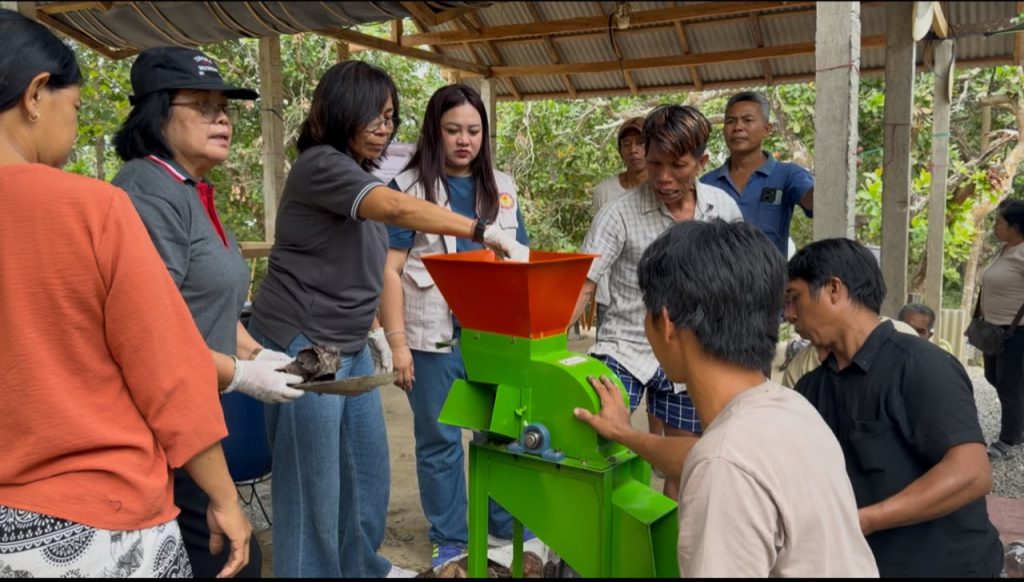
The application of technology is one of the key components of this program. Communities receive support in the form of production equipment and machinery to improve processing efficiency, including shredders, processing equipment, and gas-powered dryers.
This technology is expected to help partners produce goods through more effective processes while maintaining higher quality standards.
In addition to providing technology, the implementation team also offers hands-on training and direct guidance to the community. Some of the practical activities that have been carried out include making briquettes from cashew byproducts and producing liquid organic fertilizer from lontar palm waste.
Through these activities, the community is introduced to the concept of zero-waste processing, enabling previously underutilized agricultural byproducts to be transformed into products with economic potential.
The Kosabangsa 2026 program was carried out by a team from Triatma Mulya University, led by Executive Chair I Dewa Ayu Tita Permata Tabita, S.Psi., M.M., along with members Komang Srititin Agustina, S.ST., M.Kes., and I Nengah Juniawan, S.Kom., M.M. The advisory team is chaired by Dr. Dra. I Gusti Ayu Diah Yuniti, M.Si., with members Prof. Dr. Ir. Ni Putu Pandawani, M.Si., and Dr. apt. Ni Luh Kade Arman Anita Dewi, S.Farm., M.Biomed, from Mahasaraswati University in Denpasar.
This collaboration between the implementation and advisory teams across various scientific disciplines is expected to ensure that the application of technology is not only production-oriented but also focuses on strengthening human resource capacity, environmental sustainability, and the development of the community’s economic potential.
Through this program, the community is expected to gain better skills in processing local commodities, developing product diversification, and creating business opportunities based on the village’s potential.
In the long term, the development of a circular agroindustry based on cashew and lontar is expected to increase the added value of agricultural products, expand market opportunities, and support the economic empowerment of the Tianyar Tengah village community.
The implementation team extends its gratitude to the Directorate of Research and Community Service (DPPM) for the national grant provided through the Social Collaboration for Community Development (KOSABANGSA) Program for Fiscal Year 2026.
This funding support plays a vital role in fostering collaboration between universities and the community to deliver practical innovations, improve community well-being, and achieve productive and sustainable rural economic development.