DENPASAR, Bali (BPN/PR) – Fish farming is an activity with the potential to support increased income and food security for the community. The success of a fish farming venture is heavily influenced by the availability of high-quality feed, as feed serves as the source of energy and nutrients essential for the growth, health, and productivity of the fish.
However, the use of commercial feed remains a significant production cost for fish farmers, creating a need for more efficient feed alternatives that can utilize local resources.
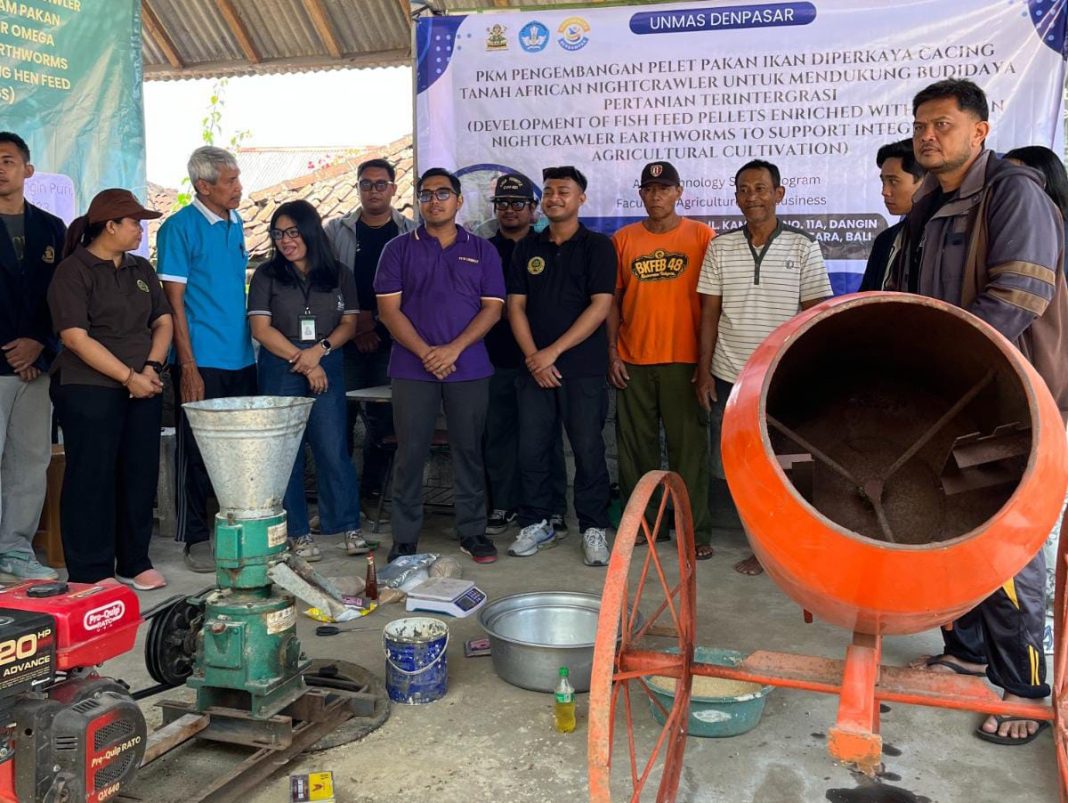
This is according to the head of the activity’s organizing team, Ir. I Made Suryana, M.Si from the Agrotechnology Study Program at the Faculty of Agriculture and Business, Universitas Mahasaraswati Denpasar through this activity.
One local resource with the potential to serve as a protein source for animal feed is the African Nightcrawler (ANC) earthworm (Eudrilus eugeniae).
The biomass of these earthworms can be cultivated by utilizing various organic materials as a growth medium. Beyond producing vermicompost—which can be used as an organic fertilizer—the earthworm biomass holds potential as a raw material or enrichment agent for fish feed, as it contains the proteins and nutrients essential for fish growth.
Incorporating ANC into pellet formulations offers a strategy for producing fish feed enriched with an alternative protein source. The earthworm biomass can be processed into meal and blended with other feed ingredients to create pellets with higher added value.
This approach also enables more optimal use of local resources and reduces reliance on feed ingredients sourced from outside the region.
This integration creates a mutually supportive relationship between agricultural activities, earthworm cultivation, and fisheries. Organic waste from agricultural operations can serve as feed or a growth medium for earthworms; the resulting vermicompost can be returned to the land as organic fertilizer, while the earthworm biomass can be utilized as fish feed. In this way, waste from one activity becomes an input for another, leading to more efficient resource use.
Implementing this system also has the potential to reduce reliance on external fertilizers and feed, lower production costs, increase the value of organic waste, and yield multiple products simultaneously—such as crops, vermicompost, earthworm biomass, and fish.
This concept aligns with the principles of a circular economy and sustainable agriculture, as it emphasizes resource reuse, waste reduction, and the efficient use of inputs.
Therefore, integrating earthworm cultivation into agricultural and fisheries systems should be developed as a business model that focuses not only on production but also on environmental management, resource efficiency, income generation, and the overall sustainability of agricultural systems.
However, utilizing earthworms as a feed enrichment agent requires further development of precise formulations and processing methods.
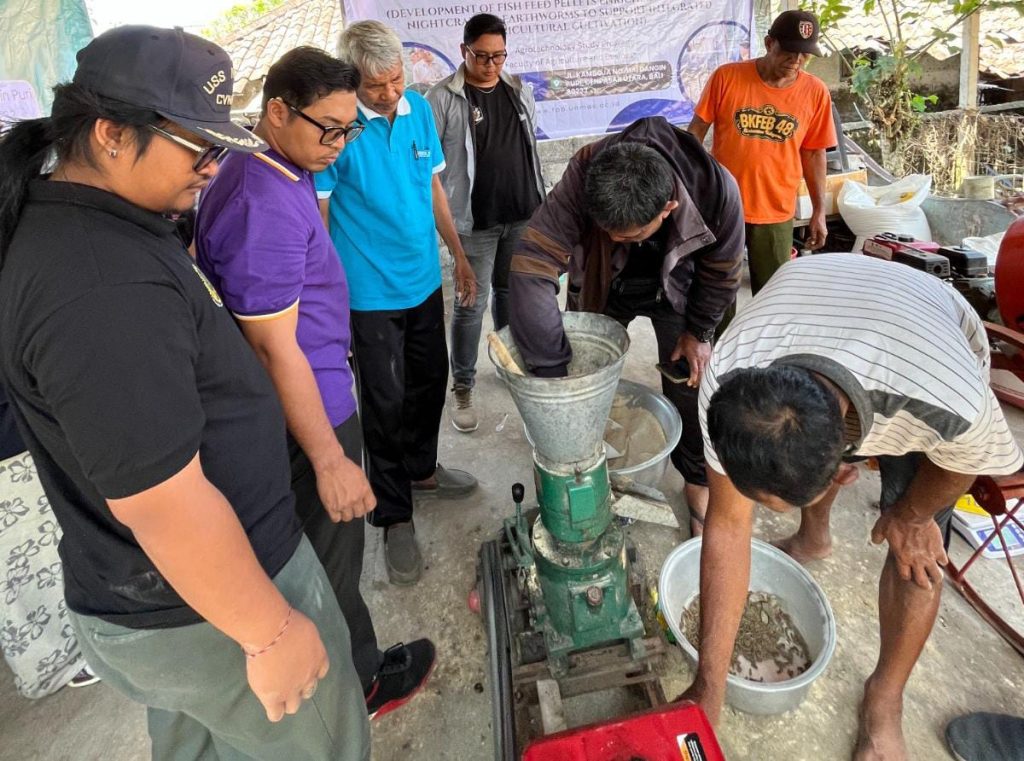
Factors such as the proportion of earthworm meal, the selection of other ingredients, and the techniques used for mixing, pelletizing, and drying must be carefully considered to ensure the resulting pellets possess the physical characteristics and nutritional content required by fish.
Consequently, initiatives focused on developing fish feed pellets enriched with African Nightcrawlers are essential for creating locally-sourced feed alternatives that are accessible and easy for the community to implement.
Such efforts are expected not only to yield alternative feed products but also to enhance community skills in ANC cultivation, biomass processing, feed formulation, and independent pellet production.
This integration can generate added value from earthworm farming while supporting the development of more efficient and sustainable agricultural and fisheries systems.
Ultimately, the development of ANC-based pellets represents an innovation that can foster feed self-sufficiency, promote the use of local resources, and strengthen the local economy.