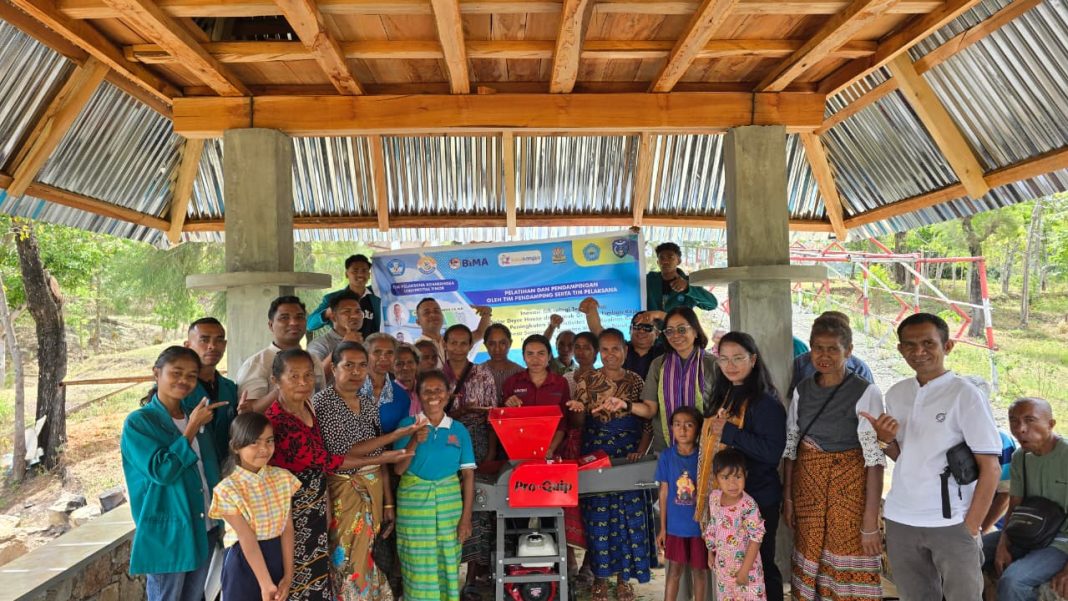
DENPASAR, Bali (BPN/PR) – As part of a strategic effort to foster community development in Indonesia’s underdeveloped regions, the implementation team of the Kosabangsa Program from Timor University (Unimor), in collaboration with a facilitation team from Mahasaraswati University Denpasar (Unmas), has conducted an intensive capacity-building initiative targeting coffee farmer groups in Suanae Village, Miomaffo Barat Subdistrict, North Central Timor (Timor Tengah Utara/TTU Regency), East Nusa Tenggara.
The program, held at the Suanae Village Hall, was warmly welcomed by the local government and community members.
The opening ceremony included a traditional welcoming ritual, featuring the symbolic presentation of ceremonial woven scarves (selendang) by village representatives, demonstrating strong community engagement and respect for cultural values.
This initiative focused on two primary community groups: the Karya Mandiri Farmer Group and the Suanae Village PKK (Family Welfare Movement) Women’s Group.
The activities were designed to enhance local capacity in agricultural processing and environmental sustainability, specifically aligned with the Kosabangsa Program’s broader vision—to bridge the gap between higher education institutions and society by leveraging science, technology, and innovation for community welfare.
The implementation team from Timor University was led by Ody Wolfrit Matoneng, S.P., M.Si., supported by faculty members and researchers: Fransiskus M.P. Keraf, S.Pd., M.Pd., Leonard Peter Gelu, S.Kom., M.Kom., Worfhardus V. Feka, S.Pt., M.Pt., and Gonsianus Pakaenoni, S.Pd., M.Sc.
Meanwhile, the accompanying team from Mahasaraswati University Denpasar was headed by Dr. I Gusti Ayu Diah Yuniti, M.Si., along with Dr. Anik Yuesti, S.E., M.M., and Dr. Ni Putu Sukanteri, S.P., M.Agb.
In his keynote address, Ody Wolfrit Matoneng emphasized the significance of the initiative as part of a national mission to empower communities located in the so-called 3T areas—Tertinggal, Terdepan, dan Terluar (Disadvantaged, Frontier, and Outermost regions).
“Our presence in Suanae Village embodies the core values of the Kosabangsa Program as envisioned by the Ministry of Higher Education, Science, and Technology (Kemendiktisaintek). This program serves as a bridge between academia and the grassroots, aiming to uplift communities through knowledge-driven empowerment. We hope that this marks the beginning of a more sustainable and independent future for the people of Suanae,” he stated.
This year’s program theme—”Appropriate Technology Innovation: Solar Dryer House and Organic Fertilizer from Coffee Waste to Enhance Coffee Productivity and Quality in Suanae Village, Miomaffo Barat Subdistrict, TTU Regency”—served as the guiding framework for the training modules and technical assistance.
For the PKK women’s group, the focus was on waste management and environmental sustainability, specifically through the transformation of post-harvest coffee waste into high-quality organic fertilizer.
The training included hands-on workshops on composting techniques, application methods, and the potential for household-scale agribusiness ventures.
Concurrently, the Karya Mandiri Farmer Group received specialized training in post-harvest technology, particularly in the construction and utilization of solar dryer houses, a simple yet effective innovation designed to improve the drying process of coffee beans.
This appropriate technology is expected to reduce post-harvest losses, enhance bean quality, and increase market competitiveness for local farmers.
Dr. I Gusti Ayu Diah Yuniti, the leader of the support team from Mahasaraswati University Denpasar, highlighted the strategic impact of the program in her address:
“Programs such as these play a pivotal role in enhancing the socio-economic resilience of rural communities. By introducing low-cost yet impactful technologies, we enable farmers and women’s groups to maximize their local resources and improve livelihoods. We deeply appreciate the warm hospitality extended to us by the Suanae Village government and its residents.”
Suanae Village Head, Patrisius Faimau, also expressed his appreciation and support for the initiative, noting that this was the first university-led empowerment activity in the village.
“We are honored and grateful for the attention and support given to our community. This initiative not only provides technical knowledge but also opens our eyes to the many opportunities available to improve our economy through innovation. We sincerely hope this collaboration will continue in the years to come.”
In addition to providing immediate technical benefits, the program is also designed to lay the groundwork for long-term collaboration between the universities and the local community.
The implementation teams will continue to monitor the adoption and impact of the technologies introduced and aim to establish a model for sustainable rural development that can be replicated in other 3T areas across Indonesia.
Through this collaborative effort, it is envisioned that the people of Suanae Village will not only gain new agricultural skills but will also develop a mindset of innovation and independence.
By transforming agricultural waste into productive resources and improving post-harvest processing, the community takes important steps toward strengthening local food systems and economic resilience in one of Indonesia’s most remote and underserved regions.